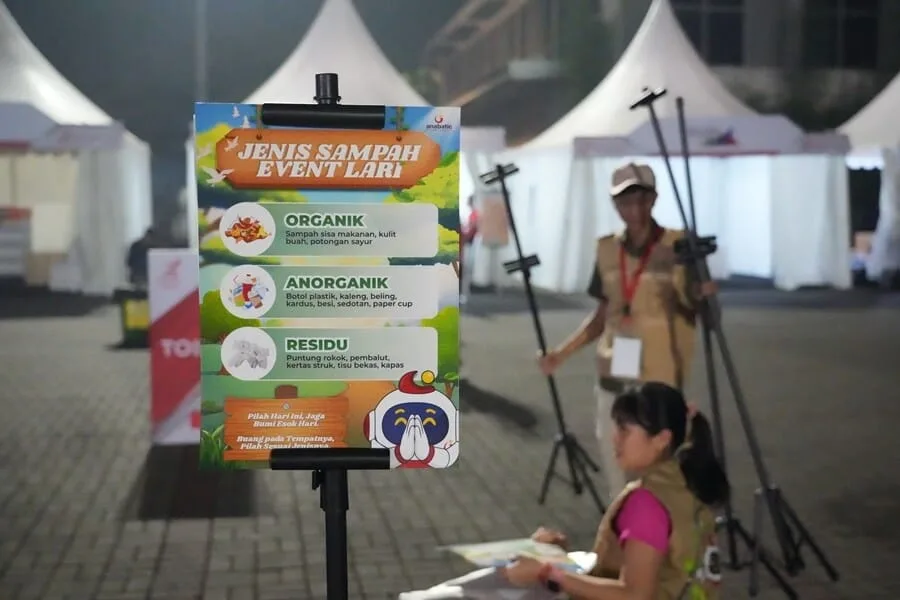
Anabatic Technologies continues to demonstrate its commitment to environmental sustainability. One of its concrete actions is through the Pasukan Semut initiative, which supported the implementation of Titan Run 2026. This initiative is part of the company’s commitment to encouraging more responsible environmental habits while inviting Anabaticians, the term used for Anabatic Technologies employees, to play an active role in maintaining cleanliness in their surroundings.
The urgency to protect the environment is becoming increasingly evident, particularly in urban areas such as Tangerang. In February 2026, the Tangerang City Government reported that the city’s waste generation had reached 1,862.6 tons per day, while the government was preparing a sustainable waste management program in collaboration with the central government.
Improper waste management can pollute land, water, and air, clog waterways and increase the risk of flooding, as well as create conditions that support the spread of disease. At the same time, waste that could still be recycled or processed may simply be discarded, further increasing the burden on landfills.
Waste composition data for Tangerang City in 2025 showed that 57.65% consisted of food waste, followed by paper at 13.18%. This condition highlights the importance of reducing and sorting waste at the source so that it does not all end up in landfills.
Therefore, waste management needs to start with simple actions and be carried out collectively. Through Pasukan Semut, Anabatic Technologies aims to demonstrate that environmental contributions can begin in the workplace and through everyday activities. Waste sorting, reduction, and processing are small steps that, when carried out consistently, can help create a cleaner and more sustainable environment.
The initiative not only focused on collecting waste, but also on sorting and processing it to ensure more responsible waste management. From the event area, 335 bags of waste totaling 4,370 kg were collected and subsequently sorted according to type to determine the appropriate management process.
The sorting process showed that approximately 55% consisted of recyclable inorganic waste, such as plastic bottles, cardboard, and paper, while 25% was organic waste and 20% was residual waste. From this process, 2,404 kg of inorganic waste was successfully distributed to recycling industries. Meanwhile, organic waste was processed through composting and utilized as fish feed. These efforts reduced the amount of waste sent to landfills to 874 kg, or approximately 20% of the total waste collected
As part of implementing the circular economy principle, the processed organic waste was also turned into compost that could be reused. A total of 15 bags of compost, each weighing 5 kg, have been received and distributed to support greening efforts at Graha Anabatic, as well as provided to Pasukan Semut volunteers as an appreciation for their contribution. This demonstrates that waste management does not have to end with disposal, but can instead create new value for the environment.
This initiative is aligned with the Sustainable Development Goals (SDGs), particularly SDG 12, Responsible Consumption and Production, through more responsible waste management, while also supporting SDG 13, Climate Action, by reducing the amount of waste sent to landfills.
Going forward, Anabatic Technologies will continue to encourage all Anabaticians to be part of environmental conservation efforts, starting with simple habits such as sorting and disposing of waste according to its type. Because protecting our planet is not the responsibility of one party alone, but a commitment we can fulfill together through small, consistent actions.
The post Pasukan Semut, Anabatic Technologies’s Real Action for a Sustainable Environment appeared first on PT Anabatic Technologies Tbk.