Governance
Management
Committees

Audit Committee
The Audit Committee is established in accordance with OJK Regulation No. 55/POJK.04/2015 concerning the Formation and Guidelines for the Operation of Audit Committees. The purpose of establishing the Audit Committee is to foster the creation of a strong internal supervision and control system, enhance transparency in financial reporting, and review the scope and accuracy of external auditor assignments.
Audit Committee Charter
The Company has an Audit Committee Charter as a guideline to regulate the duties, responsibilities, and ethical standards of the Committee, reviewed and updated periodically to ensure its alignment with a dynamic business environment.
This Charter includes the objectives of establishing the Audit Committee, composition, structure, membership tenure, membership requirements, duties, responsibilities, authorities, procedures, working methods, meeting organization, reporting, and handling of complaints.
Duties and Responsibilities of the Audit Committee
Based on the Audit Committee Charter, the duties and responsibilities of the Audit Committee include:
- Reviewing financial information to be presented by the Company to the public and/or authorities, including financial statements, projections, and other reports related to the Company financial information.
- Examining compliance with law and regulations related to Company activities.
- Providing independent opinions in cases of disagreement between management and public accountants regarding services provided.
- Making recommendations to the Board of Commissioners regarding the appointment of Public Accountants based on their independence, scope, and fees; discussing audit plans, including the nature and scope of the audit; reviewing the adequacy of examinations considering all types of risks; and ensuring coordination when assigning tasks to more than one Public Accountant.
- Reviewing planning and implementation, as well as overseeing follow-ups on internal and external auditor findings.
- Reviewing and reporting to the Board of Commissioners on complaints related to the Company’s accounting processes and financial reporting, including allegations of errors in Board of Directors’ decisions, or deviations from the implementation of Board of Directors’ decisions.
- If necessary, the Committee may conduct examinations either by itself or by assigning a third party.
- Reviewing and advising the Board of Commissioners on potential conflicts of interest, specifically when there is a conflict between the Company’s economic interests and the personal economic interests of the Company’s owners, members of the Board of Commissioners, members of the Board of Directors, Executive Officers, and/or parties related to the Company.
- Assisting the Board of Commissioners in actively overseeing the Compliance Function by:
a. Evaluating the implementation of the Compliance Function against the Company’s internal regulations and any regulations related to the Company’s activities at least twice a year.
b. Providing suggestions to improve the quality of the Company’s compliance implementation.
c. Recommendations to the Board of Commissioners regarding the appointment, termination, and performance assessment of the Head of the Internal Audit Unit.
d. Maintaining the confidentiality of the Company’s documents, data, and information.
e. Reviewing activities related to risk management implementation done by Board of Directors.
Audit Committee Composition
The Audit Committee is appointed and dismissed by the Board of Commissioners. The Audit Committee consists of at least 3 (three) members, comprising Independent Commissioners and parties from outside the Issuer or Public Company.
The Audit Committee is chaired by an Independent Commissioner.
Term of Office of the Audit Committee
The term of office of the Audit Committee members shall not exceed the term of office of the Board of Commissioners as stipulated in the Articles of Association and may be reappointed for only 1 (one) subsequent term.
Audit Committee Meetings
The Audit Committee holds meetings periodically at least once every 3 (three) months. Meetings may be convened if attended by more than one-half of the total number of Committee Audit members, in accordance with applicable provisions.
Based on the Letter of Decree of the Board of Commissioners No. 010/SK-DEKOM/CORSEC/VIII/2024 dated 26 Agustus 2024, the Company assigned the following members as the Company’s Audit Committee:
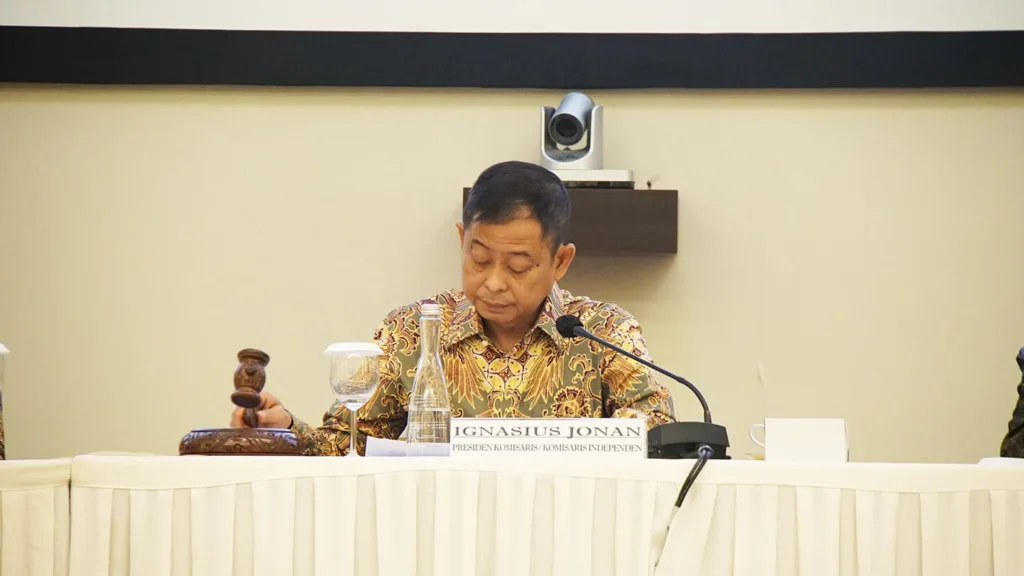
Chairman: Ignasius Jonan
Member: Yonathan Augustine
Member: Putri Timur
Nomination and Remuneration Committee
The Nomination and Remuneration Committee was established to ensure the comprehensive implementation of Good Corporate Governance (GCG) principles, particularly in matters of nomination and remuneration in accordance with applicable regulations. The Committee also serves to provide input in the decision-making process related to nomination and remuneration.
As a working guideline, the Board of Commissioners has established the Nomination and Remuneration Committee Charter, which sets out the duties, responsibilities, and working principles of the Committee in an efficient, accountable, and independent manner. This Charter is reviewed regularly to ensure its relevance to the Company’s organizational structure and business operations.
In carrying out its nomination function, the Committee provides recommendations regarding the composition, criteria, and procedures for the selection and/or replacement of members of the Board of Directors and the Board of Commissioners. The Committee also assists in performance evaluations, the development of competency programs, and proposes eligible candidates to the General Meeting of Shareholders (GMS) through the Board of Commissioners.
In its remuneration function, the Committee is responsible for evaluating remuneration policies and providing recommendations on the structure, policies, and amount of remuneration for the Board of Directors and the Board of Commissioners to be submitted to the GMS.
Through these roles, the Nomination and Remuneration Committee plays an important part in supporting transparency, objectivity, and sustainability in corporate governance, while ensuring that members of the Board of Directors and the Board of Commissioners possess the right competencies and receive compensation aligned with their responsibilities.